
Property & Casualty Insights
From Claims to Clarity: Execute Smarter Risk Decisions
JULY 7, 2026
Insurance claims often point to deeper operational vulnerabilities. Whether it’s workplace injuries, property damage, or cyber incidents, each claim tells a story. The challenge is connecting those stories to actionable insights. That’s where data-driven risk control becomes a game-changer.
Recent market volatility underscores the need for a more targeted approach. Insured catastrophe (CAT) losses are projected to reach approximately $148B in 2026, with severe weather events already driving billions in losses across the U.S.1 This level of volatility makes it increasingly difficult for organizations to rely on historical averages or generic benchmarks.
Instead, organizations need real-time, industry-specific insights that identify top loss drivers across lines of coverage. This level of clarity allows for targeted interventions that reduce claims, improve outcomes, and deliver a measurable return on investment (ROI).
When risk control is targeted and data-driven, the financial impact can be substantial. The right solution can drive a positive ROI through claim reduction, while companies that align risk control with their specific exposures also report premium reductions of up to 30%.
Proactive, Data-Led Risk Management
Traditional risk management often relies on generalized data and outdated solutions. What works for a logistics company may not apply to a healthcare provider. Each organization needs risk control strategies tailored to its unique exposures.
An effective approach starts with your data, including claims history, operational metrics, and industry benchmarks. From there, you can pinpoint which specific coverage areas (e.g., workers’ compensation, general liability, auto) are driving costs. Once you identify those cost drivers, you can evaluate targeted solutions designed to mitigate those risks.
Evolving catastrophe models are expected to significantly increase modeled losses in some regions, in certain cases by more than 100%.2 This further emphasizes the need for proactive, data-driven risk strategies.
Six Steps to Smarter Risk Control
To reduce costs and improve claim outcomes, use the following strategic framework:
- Start with your industry and data — Avoid generic benchmarks. Use data that reflects your specific operations, size, and geography.
- Focus on high-impact coverage lines — Identify which lines of coverage are contributing most to your claim costs.
- Identify top loss drivers — Drill down into the root causes of losses within each coverage line.
- Evaluate targeted solutions — Assess available risk control measures that directly address your top loss drivers.
- Prioritize based on ROI — Allocate resources to solutions that offer the highest return on investment.
- Leverage strategic partners — Work with brokers, carriers, and vetted vendors to implement solutions and track results.
Strategies That Deliver Measurable ROI
USI’s proprietary PATH platform draws on insights from hundreds of thousands of commercial insurance clients to develop and recommend innovative, cutting-edge solutions designed to address the top sources of loss by industry.
Consider the following scenario: a manufacturing company is facing increasing workers’ compensation costs and wants to identify the most cost-effective way to reduce these expenses. PATH helps the client pinpoint the top loss drivers, including being struck by objects, overexertion, slips/trips/falls, repetitive motion, or being caught in or between objects. The platform then compares hundreds of potential solutions and highlights the options best suited to address those risks.
One effective solution is wearable technology — a lightweight device that an employee attaches to their waist, arm, or back to help prevent injuries. Using PATH’s financial calculators, the client can estimate the year-one ROI based on its loss history. In this scenario, the company experiences approximately 11 losses each year, with an average cost of $60,000 per incident. That equals $300,000 in annual losses. A $32,000 investment in this wearable technology could generate $180,000 in first-year savings — a 460% ROI.3
PATH then generates a five-year ROI projection based on different plan components, including potential premium impact. It also identifies 20 potential vendors that offer the recommended technology. This projection includes vendor evaluation scores, feature comparisons, and preferred pricing. Curated vendor partnerships can help streamline implementation and reduce costs. The client can customize the analysis based on various inputs, with revised results and calculations being generated within seconds.
How USI Can Help
PATH™ – Uncover Top Business Risks & Unlock Significant ROI
USI PATH is a proprietary risk control platform that delivers an interactive and transparent journey through the complex risk-control process. Offering indisputable data and a clear view into your industry risk profile, PATH provides:
- Valuable insights into key loss factors and their impacts through a real-time, interactive experience.
- A way to uncover areas of potential improvement for your risk control programs and a path toward better claims results.
- Curated vendor solutions with preferred pricing and ROI projections.
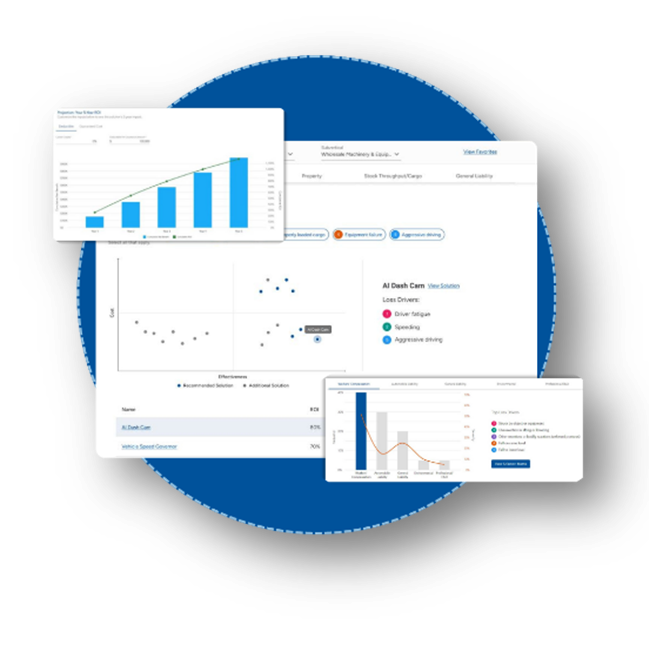
PATH will enable you to gain clear insights with visibility into top loss drivers and impact, including improvement areas by line of coverage to generate meaningful ROI and improve claims and outcomes.
3,330+
Risk control
solutions available
97%
Solutions offering
multiple products to
better address your needs
9:1
ROI on personal
safety alert devices
noticed in year 1

To learn more about USI PATH and our targeted approach to risk management, contact your USI representative or email pcsolutions@usi.com.
1 2026 Commercial Property & Casualty Market Outlook Mid-Year Addendum, p. 6
2 2026 Commercial Property & Casualty Market Outlook Mid-Year Addendum, p. 7
3 This assumes the company uses a loss-sensitive program. While a guaranteed-cost program would not receive the immediate full impact of a reduction in claims, the five-year cumulative premium savings could be $135,000.
SUBSCRIBE
Get USI insights delivered to your inbox monthly.
